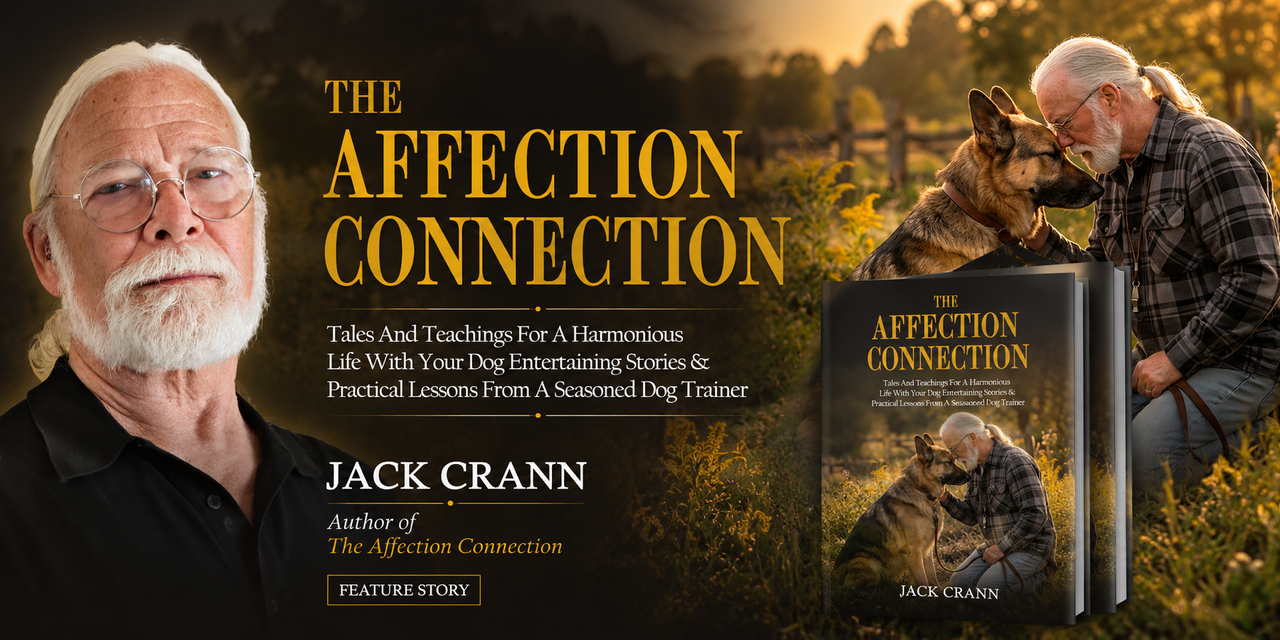
For more than three decades, Jack Crann has helped dog owners across the country better understand one simple truth: dogs are not responding to our words nearly as much as they are responding to our behavior.
Now, in his newly released book, The Affection Connection, Jack brings together over 30 years of hands-on experience in canine behavior, communication, and owner education to challenge many of the misconceptions people have about training dogs.
Rather than focusing on obedience drills alone, Jack introduces a philosophy centered on communication, emotional clarity, and relationship-building. His approach moves beyond traditional “training” and instead emphasizes “teaching,” helping owners understand why dogs behave the way they do and how everyday interactions shape that behavior.
“People often think training only happens during practice sessions or group classes,” Jack explains. “But dogs are learning from us every moment of the day. Teaching is about creating a relationship where the dog looks to you for guidance in everyday life.”
One of the book’s central themes is that dogs live entirely in the present moment. According to Jack, many owners unintentionally reinforce negative behavior by giving attention at the wrong time. Whether it is comforting a fearful dog, yelling at a barking dog, or reacting emotionally to unwanted behavior, dogs often interpret attention itself as a reward.
“The biggest misunderstanding is that people think correction means punishment,” Jack says. “In reality, correction should simply redirect the dog’s attention so you can teach them what you actually want them to do.”
This philosophy is reflected throughout The Affection Connection, where Jack repeatedly emphasizes that “you can’t teach don’t.” Instead of telling dogs what not to do, owners must consistently teach them the behaviors they should perform instead.
The book also explores how human energy and emotional responses directly influence canine behavior. Jack believes many behavioral issues stem less from the dog itself and more from inconsistent communication from the owner.
“One of my favorite lines in the book,” he shares, “is that your dog responds to the way you respond to the dog.”
What makes Jack’s story unique is his unconventional professional background. Before becoming a respected dog behavior educator, he made his living as a professional dancer. When not performing or rehearsing, he taught, “In the dance world, I discovered not only that I could teach but that I loved teaching. I worked on learning how to be a good teacher, and applying those skills to teaching people how to teach their dogs has been a great experience.”
Throughout the book, Jack shares deeply personal stories from his career, including emotional rehabilitation cases involving rescue dogs and aggressive behavioral situations that others believed were beyond saving. In one particularly moving story, he recalls helping rehabilitate a dog that was scheduled to be euthanized after multiple biting incidents. Through patience, structure, and proper communication, the dog was eventually successfully socialized and remained with its family for many more years.
Another powerful story features a severely traumatized rescue dog named Jack, who had been abandoned and developed extreme fear-based behaviors. Jack worked with the dog for months before witnessing an unforgettable moment of connection between the animal and its eventual adopter.
“They looked at each other like they had been waiting for one another their entire lives,” Jack recalls.
At the heart of The Affection Connection is the idea that affection itself can become a communication tool when used correctly. Positive eye contact, calm energy, consistent structure, and timely praise all become part of what Jack calls “the affection connection”, a relationship where dogs clearly understand when they are making the right choices.
As conversations around dog behavior continue evolving, Jack’s message offers a refreshing reminder that successful relationships with animals are built not through dominance or fear, but through understanding, consistency, and meaningful communication.
With decades of real-world experience behind him, Jack Crann is not simply teaching people how to train dogs… he is teaching them how to truly connect with them.
https://www.youtube.com/@jackcranndogtraining