You hired an agency. They built a media plan. They ran the same channels they always run. Three months later, you have reports full of impressions and no real idea what drove pipeline.
That is traditional advertising. It is not broken for everyone. But for founders with tight runways and investor pressure, it is too slow and too opaque.
Ai-driven marketing works differently. Here is how the two approaches compare — and why it matters for startups specifically.
What Most Tools Get Wrong
Traditional agencies optimize for deliverables. They ship creative. They run campaigns. They report on what happened last month.
AI-driven approaches optimize for outcomes. Every decision is tied back to performance data. Every creative goes through structured testing. Every budget shift is justified by live signals.
The difference is not the tools. It is the operating logic.
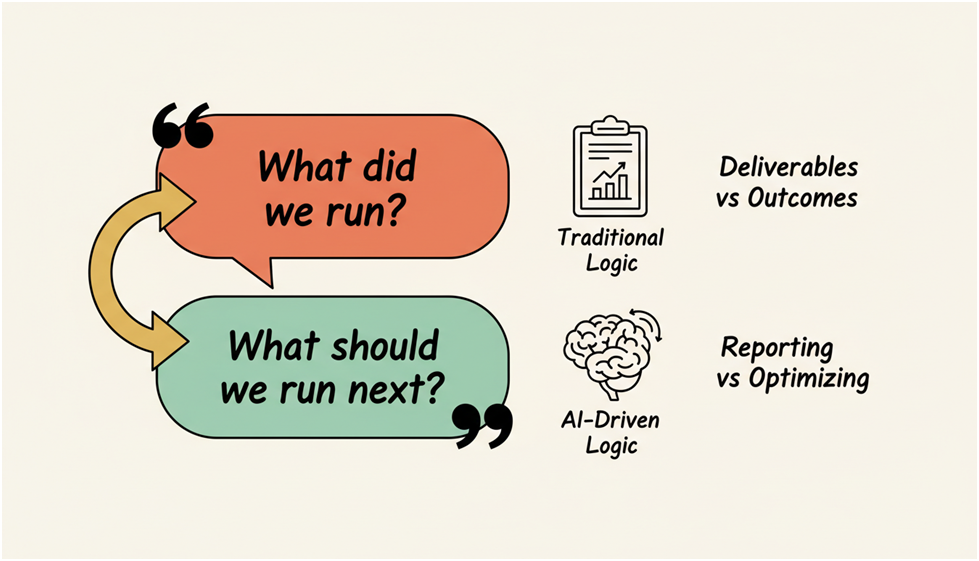
Traditional advertising asks: “What did we run?” AI-driven marketing asks: “What should we run next?”
Criteria Checklist: What to Demand From an AI Marketing Agency
Multi-Platform Campaign Management
Traditional agencies often specialize. Google shops. Social shops. Siloed execution means siloed learning.
Artificial intelligence advertising platforms unify that data. What you learn on Meta informs your Google bidding. Your LinkedIn performance shapes your audience strategy everywhere else.
For founders making cross-channel bets, that integration is critical.
Continuous A/B Testing
Traditional marketing runs a campaign. Evaluates it. Runs the next one. That cycle takes weeks.
AI-driven testing runs concurrent experiments on ads, audiences, and landing pages. Losing variants get cut fast. Winners scale before the market shifts.
Speed of learning is a competitive advantage.
Real-Time Performance Tracking
Monthly reports are a lag indicator. By the time you see the data, the campaign has already run. Mistakes compound.
Real-time tracking lets you course-correct within hours, not weeks. For startups managing burn, that speed is not a nice-to-have. It is survival.
Data-Driven Budget Allocation
Traditional agencies propose a budget split at the start of a campaign. That split rarely changes unless you push hard.
An ai marketing agency reallocates dynamically. When one channel outperforms, spend flows there automatically. When one underperforms, it gets pulled.
Your budget works harder without you touching anything.
Full-Funnel Ownership
Traditional models separate strategy, creative, and buying into separate teams or vendors. Each blames the other when performance drops.
AI-driven agencies own the full funnel. Strategy, execution, testing, and reporting in one place. That removes the blame gap and keeps optimization continuous.
Attribution Modeling
Traditional reporting shows you reach and frequency. Sometimes click-through rates. Rarely actual conversions.
AI-driven marketing builds attribution models that trace a customer’s path from first ad to closed deal. You see which channel, which message, and which audience actually drove revenue. The right ai powered advertising builds these capabilities into every campaign from day one.

Practical Tips for Founders Making the Switch
Audit your current reporting. If your agency cannot tell you your true cost per acquisition by channel, that is your first problem to solve.
Run a parallel test. Keep one traditional channel running. Add one AI-optimized campaign. Compare results over 60 days. Let the data make the argument.
Align on startup metrics. Your agency should care about CAC and payback period. Not just CPM. If they do not, they are not thinking about your business.
Demand weekly transparency. Not monthly decks. Live dashboards you can check yourself.
Expect iteration cycles, not campaigns. Traditional advertising delivers campaigns. AI-driven marketing delivers continuous improvement loops.
Competitive Pressure Close
Traditional advertising built the brands you compete against. That is not a reason to copy it.
Those brands have the budgets to absorb inefficiency. You do not.
Ai powered advertising closes the gap by moving faster, allocating smarter, and learning continuously. The founders who make that shift early compound their advantage while competitors run last quarter’s playbook.

Your timeline is shorter than theirs. Your approach needs to match.