An article on Dave Siemienski’s Home With the Wind: Adventures in Bone Valley with the Dinospikes, Book 2 in the Dinospike series
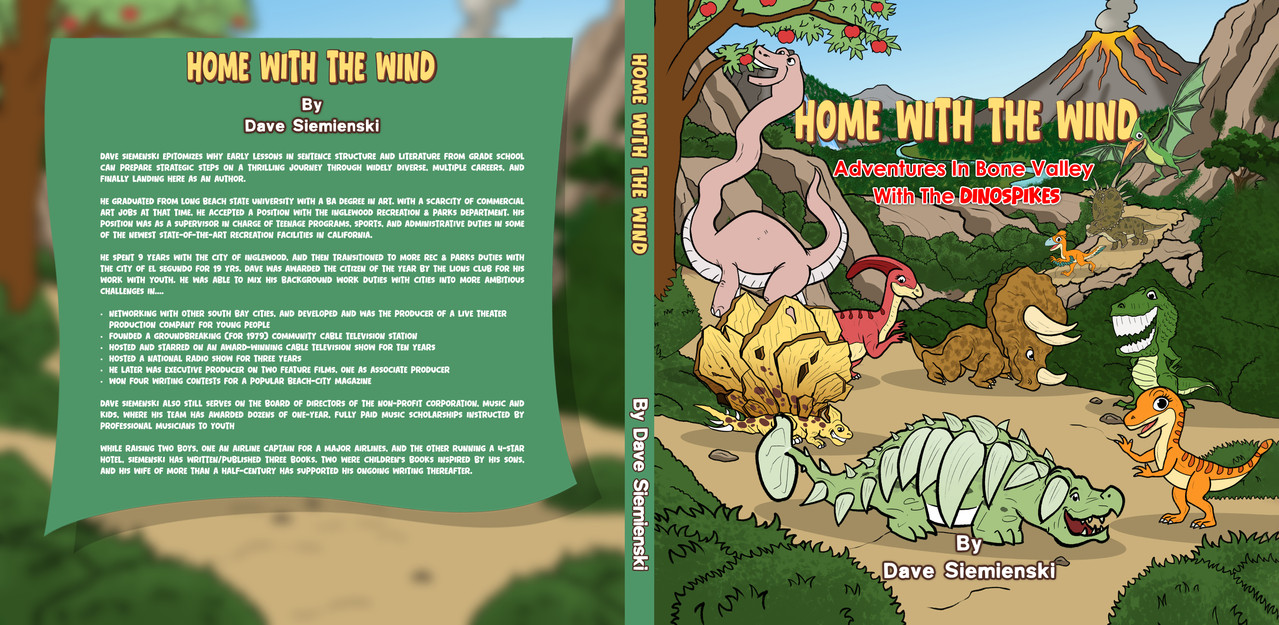
Children’s picture books about storms usually do one of two things. They either soothe a child’s fear of bad weather, or they use the storm as a backdrop for adventure. Dave Siemienski’s Home With the Wind does both, but its real subject is something quieter and harder to teach: what it means to be loyal to the friend who can’t keep up.
The book is the second title in Siemienski’s Adventures in Bone Valley series, which follows a group of dinosaur friends called the Dinospikes. Where the first book centered on Plato, a Stegosaurus teased for the large plates on his back, this one turns to Anky, a slow, low-to-the-ground Ankylosaurus who spends most of the story trying to catch up.
The Setting: Bone Valley
The story opens with a classic fairy-tale line: “Long ago and far, far away, in a land that time almost forgot.” Bone Valley is a rocky, green place full of mountains, rivers, trees, and lakes, with plenty of room for its big residents to roam. It also has a clear geography that the story uses well. There is Logging Lake, fed by the usually gentle Crooked Creek. There is Voo Doo Volcano looming on one side. At the far end stands Rocky Ridge, home to the valley’s largest caves and to Boulder Bridge, the only way in or out.
This map matters, because once the storm arrives, the characters have to cross all of it. Young readers can track the journey from the berry bushes, past the lake, over the flooded creek, and up to the ridge. It gives the story a sense of distance and danger that keeps pages turning.
The Story
It is the tail end of winter. Anky and three friends, Necko, Sara, and Plato, are eating together on the forest floor. Necko, a long-necked Dinospike, eats from the treetops. Anky, who can never reach that high, happily eats from the low berry bushes instead.
The wind picks up. Necko, who can see above the trees, spots the coming storm first. Nosey, a flying Dinospike, lands with the same warning. Then Proto, the oldest and wisest of the group, explains that this is no ordinary rain. He has seen a storm like it once before, and it can rip trees out of the ground. Later in the book he gives it a name: a hurricane.
The group heads for the caves. Anky, the slowest of them all, quickly falls behind.
What follows is a series of rescues, and every one of them is carried out by Anky. He finds Dina trapped under a fallen tree and pushes it off her legs. He reaches a flooded creek where Sara and Rapper are struggling, jumps in, and anchors his spiked body into the rocks to become a living bridge. When Sara slips into Logging Lake, he paddles after her and lets her grab his clubbed tail like a life ring.
Each rescue costs him. He is exhausted, covered in mud, and further behind than ever. At one point he is alone in the storm, calling out to friends who can’t hear him over the thunder. “Why aren’t they waiting for me? I can’t keep up!” It is the emotional low point of the book, and it is written with real tenderness.
Meanwhile, up on Rocky Ridge, the others have found a cave large enough for everyone. But the opening is wide, and wind, rain, and debris are blowing straight in. Tri-Bone tries to push boulders in front of it, but the mud makes it hard and the gaps remain.
Then Plato asks, “Where is Anky?”
The friends realize what has happened, and they decide to act together. Nosey flies back out into the storm, finds Anky climbing slowly through broken branches, and leads him up the trail.
When Anky arrives, the cave is full and the opening is still exposed. A tree crashes down nearby. Without fear, Anky climbs onto the rocks and stretches his armored body across the entrance. His spikes cover the gaps, his tail plugs one side, and his head fills the last crevice. “Anky was the locked-door of the cave.” The friends ride out the worst hurricane in Bone Valley’s history, dry and safe behind him.
When the skies clear, the Dinospikes lift Anky over their heads, and Rex makes a promise on behalf of the group: “We will never leave him, or anyone else, behind again. Our loyal friend is our best shelter in a storm!”
The Themes
Differences as strengths
The central idea of the book is that the traits that make Anky slow are the same traits that make him a hero. His low body lets him brace against the ground and push a tree off Dina. His spikes grip the creek bed to form a bridge. His tail becomes a lifesaver. And his heavy, armored frame is the only thing in the valley that can seal the cave.
This is the same idea that runs through the first book, where Plato’s teased-about plates end up saving the day. Across the series, Siemienski is building a clear message for young readers: the thing that makes you different may be the thing the world needs most.
Kindness that costs something
Many children’s books show kindness as easy and instantly rewarded. Home With the Wind is more honest. Every time Anky stops to help, he loses ground. He knows it, too. When he sees Dina, he “looked up at his friends vanishing into the storm, but he knew Dina needed help right away.” He chooses to help anyway. The book doesn’t lecture about this. It simply shows a character doing the right thing when it is hard, and lets children feel the weight of that choice.
Loyalty as a choice
The other Dinospikes are not villains. They are scared, the storm is fierce, and they rush ahead. That makes the turning point more meaningful. Nobody tells them to go back for Anky. They notice he is missing and decide together that they can’t leave him. Cory’s line, “Whatever we do, we must do it together,” and Necko’s reply, “we have to be loyal to each other,” frame loyalty as an active decision rather than a feeling.
The final lesson brings both sides together: “if you stay true to your friends, they will surely be there when you need them the most.” Anky was there for his friends, and in the end they were there for him.
Facing fear
The book also works as a gentle introduction to severe weather for young children. It names the hurricane, shows the wind, rain, flooding, and falling trees, and models a calm response. Listen to those with experience. Look for shelter. Stay together. Help each other. It is frightening in the right amount, and it ends in sunshine.
The Illustrations
The artwork is bold and colorful, with a clear, cartoon-like style that suits young readers. The color story carries much of the drama. The valley starts in bright greens. As the storm builds, the pages shift into deep purples, grays, and muddy browns, with sideways rain, swirling leaves, and bending trees. The cave scene is dark and close, with Anky’s spiked back pressed against the rocks. The final spread opens back up into blue skies, a waterfall, green hills, and all the friends gathered in the light.
Each character has a distinct shape and color, which helps young listeners keep track of a fairly large cast. A character lineup at the back introduces all nine: Sara, Rex, Plato, Tri-Bone, Rapper, Necko, Nosey, Dina, and Proto.
About the Author’s Purpose
Siemienski dedicates the book to his two sons, Chad and Shane, and writes that before they could read, he tried to share with them “the joy and wisdom of living that very often came from books that I read to them.” That intention shows. Home With the Wind reads like a story built for the lap, with clear action, repeated danger, simple dialogue, and a lesson that a parent can return to long after the book is closed.
Who It’s For
The book suits children roughly between the ages of 3 and 8. Preschoolers will follow the storm and the rescues. Early elementary readers will pick up on the deeper ideas about kindness, inclusion, and loyalty. It would work well in classrooms during units on friendship, character education, weather, or dinosaurs, and it is a natural pick for families with siblings of different ages and abilities.
Questions to Talk About After Reading
- Why did Anky stop to help Dina, even though it meant falling further behind?
- How did Anky’s spikes, tail, and short legs help him save his friends?
- How do you think Anky felt when he was alone in the storm calling “Please wait up”?
- Who noticed Anky was missing? What did the friends decide to do?
- Have you ever been left behind? Have you ever forgotten to wait for someone?
- What does it mean to be a loyal friend?
- What would you do to stay safe in a big storm?
The Takeaway
Home With the Wind is a dinosaur adventure on the surface, with a hurricane, a flood, falling trees, and a race to safety. Underneath, it is a story about the friend at the back of the line. It tells children who feel slow or different that they have something valuable to give. And it reminds everyone else to look around, count heads, and go back for the ones who are missing.
As Rex puts it at the end of the storm, a loyal friend is the best shelter there is.